
A Tireless Effort: Lambertville’s 1942 Rubber Drive
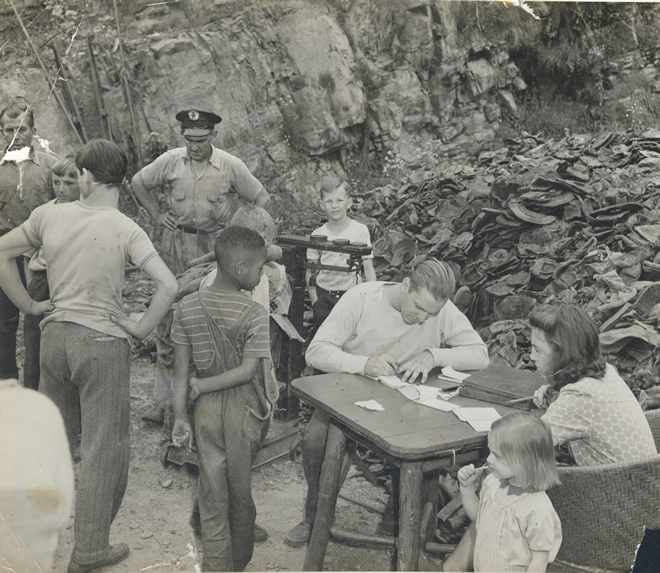
Lambertville residents take part in the national campaign to collect rubber during the summer of 1942. Photo courtesy of Jack Marriott.
 {In conjunction with our current exhibition, Answering the Call: 250 Years of Service and Sacrifice in Hunterdon County, the Society is sharing stories that highlight our community’s contributions and sacrifices during times of war. In this first installment, we look back at Lambertville’s remarkable effort to collect scrap rubber in 1942 to support the wartime effort. To learn more about Hunterdon County’s history of service and sacrifice, we invite you to visit our new exhibition at the Doric House Museum.}
They called it the “Lambertville Rubber Rush of ’42,” as residents from throughout the town joined forces to collect scrap rubber for the war effort.
During World War II, rubber was essential to keeping military vehicles, aircraft and other vital equipment operating. The need became especially urgent after Japanese forces captured much of Southeast Asia, cutting off Allied access to a major source of the world’s natural rubber supply. Rubber was also needed to manufacture gas masks, life rafts and pontoon bridges. Communities across the country answered the call, organizing local drives to collect every usable scrap.
Lambertville, however, had something of a secret weapon in its effort: the former Century Tire and Rubber plant at 902 North Avenue. About 20 years earlier, the factory had manufactured automobile tires and rubber tubing. In those days, when a rubber shortage would have seemed almost unimaginable, production trimmings and scraps were simply discarded on a nearby rubber heap. What had once been considered waste would now prove to be a valuable resource.
In 1942, the Samoset Laundry operated at the site. Its employees and a group of volunteers and children mined the buried treasure, using their fingers to sift through the dirt and pull out the rubber. Running the operation was Albert Merola, who rested upon a pile off scraps while “his crew” excavated. On the first day, the effort yielded 150 pounds of scrap. The crew collected another 200 pounds on the second day. Others working on the project were Michael DeLucca; John, Tony and Sonny Wood; Charles Tempesta; Angelo Mone; and Dominick and Joseph Schiano.
As the operation continued, Sam Marriott over at the Texaco station on Route 29 told the collectors he would take up any rubber they managed to dig up. He also delivered water, lunch, beer and cigarettes to the collectors. (We presume the adults, though the article doesn’t specify.)
Crews searched throughout the area for every available scrap of rubber and, by mid-July 1942 when the drive ended, had collected an impressive 328 tons. The largest portion was delivered to Heath and Allen’s Garage, located at the corner of Church and North Main streets.